Unlock Voices. Change Lives.
Your Child Has So Much to Say.
Empowering authentic and autonomous communication, one letter at a time. Occupational therapy support for non-speaking Autistic youth aged 10 to 18 to find their voice via the Rapid Prompting Method (RPM).
Registered OT + RPM Level 3 Practitioner · Funding eligible RPM support across BC
We presume competence
We believe
your kid is in there.
As many as one in three Autistic children remains non-speaking or minimally speaking[1], and roughly a third of high-tech AAC devices end up abandoned[2].
“The device is in a drawer.”
Thousands of dollars, months of programming, hundreds of hours of modelling. It ended at “iPad” and “snack”.
“We stopped being offered anything.”
At some point the goals shrank to requesting and tolerating. As if that’s all a 14-year-old has to say.
“The assessments say they don’t understand.”
Assessments that required speech and fine motor control to prove comprehension. The score measured a body, not a mind.
“Everyone talks about them like they aren’t in the room.”
You watch your kid’s eyes while it happens, taking in every word, and you know they’re wrong.
“It’s year six of identifying colours.”
Point to red, match the shape, sort the bears. Years of it. Not because your kid can’t do more. Nobody presumed there was more.
If any of that sounds familiar, you’re in the right place. Your family isn’t out of options.
A Case Study
“She’s my queen.”Asked about his mom for the first time, with her sitting beside him.
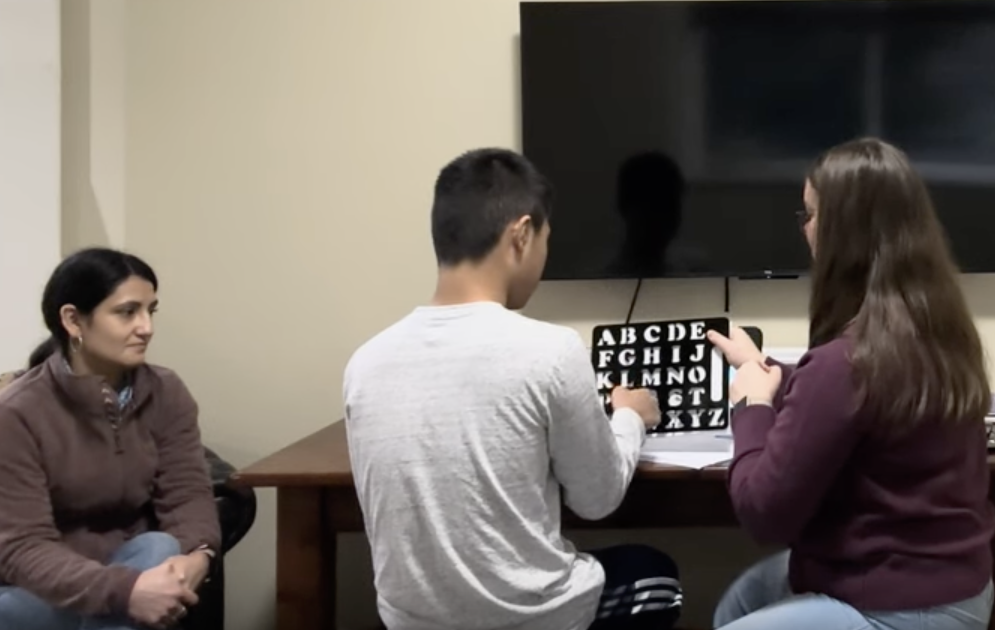
For years there was so much his team and family didn’t know. What he understood. What he knew about his family. Whether he had anything to say at all. His first full sentence answered a tidbit: “No, I love chicken.” Now we know he wants a girlfriend. He wants to learn to play Nintendo. He doesn’t want his sister to leave for university. He has a sharp sense of humour. And his favourite thing from 2025 was finally, at 17yo, “learning to talk.” He meant spelling.
The method
What’s the Rapid Prompting Method?
Rapid Prompting Method (RPM) is a low-tech, educational approach to communication. Lessons pair age-respectful teaching with purposeful pointing on a letterboard, building the motor skill of spelling until it becomes a reliable way to express real thoughts. No device, no software. A board, a communication partner, and consistent practice.
Competence & capability exists.
RPM begins with the belief that non-speakers have inherent understanding and are fully capable of comprehension and expression, regardless of prior success with AAC or speech therapy.
Support the body, trust the mind.
Non-speaking communication in Autism is a sensory and motor support need, not an intellectual one. Shifting from fine motor (speech) to gross motor (pointing/spelling) makes expression more accessible for dyspraxia.
Real learning comes first.
Communication grows out of engagement with real content. Science, history, stories, ideas. Spelling during age-respectful lessons builds motor skills without ABA-style drills. Never baby talk.
The program
How it works.
A telehealth model built around one idea: the person who sees your kid every day becomes the person who can teach them. The Boardside Coach™. We train and support that person. Consistency does the rest.
Book a free 15-minute call
We talk about your kid, your team, and whether this program is the right fit. Honest answers either way. No pressure, no waitlist games.
Request a call nowChoose your Boardside Coach™
The Boardside Coach™ is the person who handles the letterboard, delivers lessons, and provides prompts day to day. It’s either you (a committed caregiver we train from zero) or a support worker your family already employs. In some locations, our trained OTAs can take this role. No prior experience needed. We build their skills the same way we build your kid’s: step-by-step.
Practice short and often
15-minute lessons, 3 to 5 times a week, delivered by your Boardside Coach™. Sessions can be split into shorter blocks to match tolerance and regulation. Consistency beats intensity.
We stay wrapped around you
Weekly remote lessons led by an RPM Level 3 practitioner, with your Boardside Coach™ on the letterboard. Weekly coaching calls with the Boardside Coach™ to review videos, answer questions, teach methodology. Quarterly home visits or workshops for progress assessment and strategy.

The road ahead
Letters → opinions.
Every speller moves at their own pace. These are the stages we teach toward, and what they actually mean.
Closed Speller
Learning motor patterns, building tolerance, and establishing a routine with structured letterboard lessons.
Elbow up to spell poet. Points to dictated lettersP … O … E … T
Semi-Open Speller
Accurately pointing to dictated letters, engaging in prompts like letter tennis and fill-in-the-blanks. Beginning to answer open-ended questions.
During a lesson: _____ is a country with pyramidsEGYPT
Open Speller
Expressing opinions, making autonomous choices, and demonstrating deeper knowledge. This is where the person shows up in full.
When asked what this week's lesson should bePI 314159
Transitioning
Expanding to multiple Boardside Coaches™ and board types, integrating spelling communication into daily life.
On a Tuesday, in the kitchen with momORDER PIZZA PLZ
A year, give or take.
The honest timeline
Progress is highly individual. It depends on consistency, trust, age, sensory needs, and Boardside Coach™ learning! Many kids arrive after years of being misunderstood or drilled for compliance, so building real communication takes patience and relationship.
Some participants become semi-open within a couple months, others after a year or more. Many become fully open spellers. We tell you this so you can plan for a marathon, not a sprint. The goal is real autonomy, not performed compliance.
The pilot cohort
Is this right for your family?
Our caseloads are deliberately narrow. Honest fit matters more to us than a full roster.
Right for
- Non-speaking or minimally speaking Autistic youth aged 10 to 18, anywhere in BC
- Families with a caregiver or support worker (like a BI) who can deliver 15-minute lessons 3 to 5 times a week. In select locations, our OT Assistants can deliver this.
- Teams ready for a year-plus commitment, built on relationship rather than compliance
- Families who’ve been failed by high-tech AAC and want a structured, supported alternative
At this stage, it isn’t for
- Children under 10, in most cases. Spelling leans on motor precision and attention stamina that are usually still developing before then, and starting too early risks frustration instead of momentum.
- Families looking for a guarantee or a quick fix. We don’t sell either.
- Teams who can’t commit to consistent weekly practice. Frequency is the engine of this program.
Not sure which side your family lands on? That’s exactly what the call is for.
Who we are
Clinician-led, family-taught.
RPM Centre of BC is an Everyday OT company in collaboration with Mentoring Minds. Designed for telehealth, we bring RPM support across BC. And since it's OT-led, many BC families can use funding to avoid paying out of pocket.
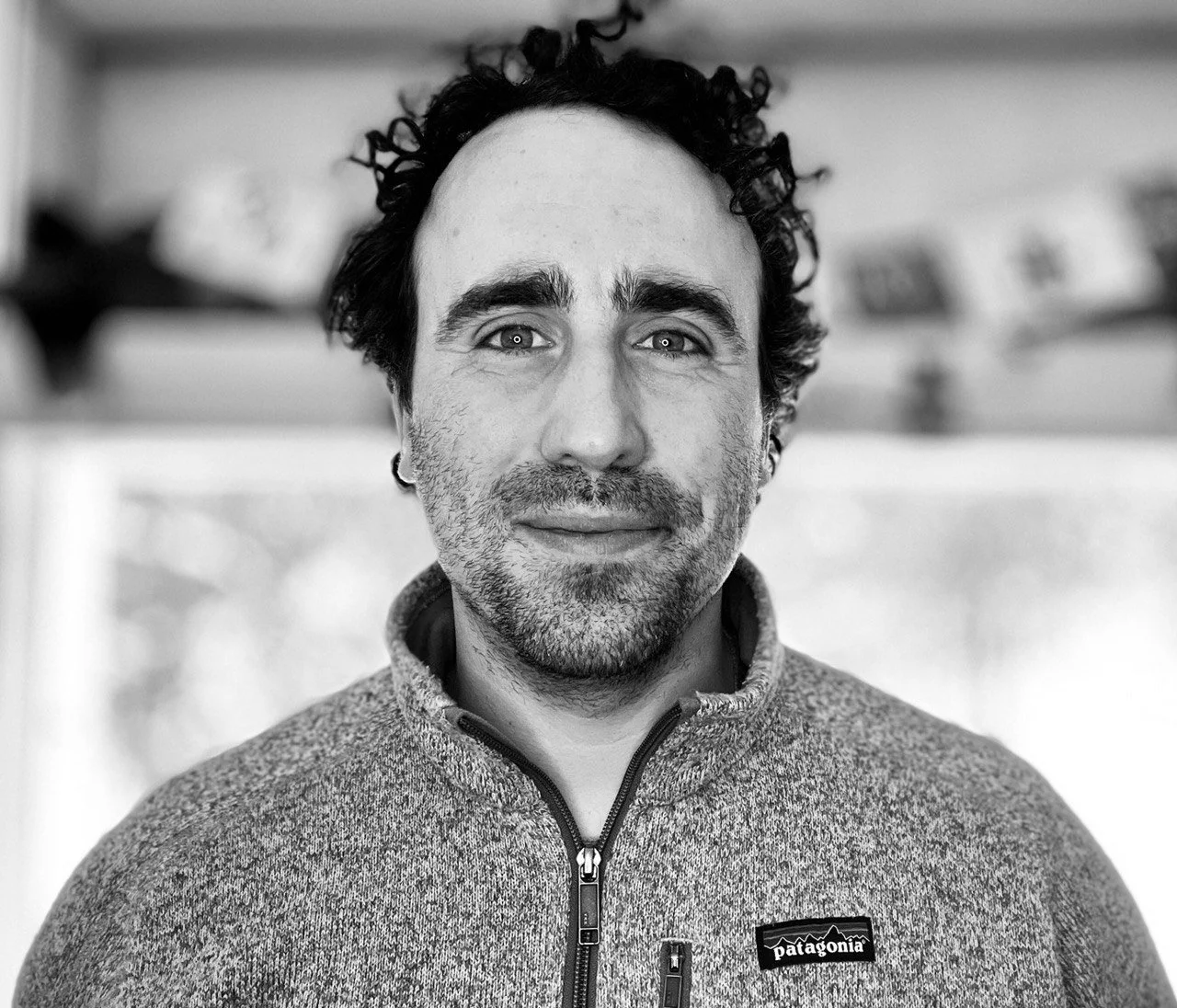
Luc Jeanneau
Director of RPM Centre of BC, Everyday OT, & Autism Sleep · Occupational Therapist
Over 12 years as an OT, Luc has worked alongside Autistic and AuDHD children, teens, and adults while building Everyday OT into one of BC’s first neuroaffirming practices grounded in the Neurodiversity Paradigm. He founded RPM Centre of BC because non-speaking and minimally speaking Autistic people remain deeply misunderstood and poorly served by systems, much as Autistic people broadly have been for generations, and he believes justice begins with presuming competence and creating access to communication now.

Madison Imber
Director, Mentoring Minds · RPM Level 3 Instructor · OTA
Since beginning her RPM work in 2017, Madison has become a committed ally to the non-speaking Autistic community and one of Western Canada’s pioneering RPM providers, supporting clients across a wide range of ages, diagnoses, and learning profiles. She brings hands-on expertise to RPM Centre of BC, meeting each client where they are and helping families build the practical skills, confidence, and consistency to support autonomous ommunication one letter at a time.
Questions
Asked and answered.
Why an OT and not a speech therapist?
Because for most of our clients, this isn’t a speech problem. Non-speaking doesn’t mean non-comprehending. When a child understands you and still can’t answer, the barrier usually isn’t language. It’s getting a body to execute what a mind intends: motor planning, initiation, sequencing, sensory regulation, and the sustained coordination it takes to reach a letter on purpose.
That is occupational therapy’s home ground. We treat spelling as a motor skill built through practice, in the environments where your child actually lives.
We’ve already done speech therapy and AAC. Why would this be different?
Speech-language pathology owns real territory and we refer to it. Articulation, expressive and receptive language, swallowing: if that’s the barrier, an SLP is who you want, and we’ll tell you so.
What the AAC field as a whole has struggled with is access and follow-through. Device abandonment is one of the most persistent problems in augmentative communication, and it usually traces back to motor demand, poor fit, or a system that never made it into daily family life. Those are precisely the variables OT is trained to solve, and it’s why daily practice at home is built into the program rather than left to chance.
How do you know the words are my child’s own?
That’s the right question, and it’s the standard we hold ourselves to: communication counts when it’s demonstrably the speller’s own. We work toward autonomous spelling, fade prompts deliberately, video-document progress so you can see the change yourself, and involve caregivers throughout. Our case studies aren’t RCTs. But when n=1 is your child, it makes all the difference.
Is RPM evidence-based?
RPM is contested, and we’ll say it before you google it. SLP professional bodies worry a facilitator holding the board could influence the message, and the peer-reviewed base is thin. Those concerns deserve an answer, not a dodge.
Evidence also includes the people it’s about. Non-speaking advocates who spell to communicate have said for years that presuming competence changed their lives. When research lags behind lived experience, the honest move is to listen to both.
What about prompt dependency?
It’s the most important nuance of this field and we treat it that way. Prompts are a motor scaffold, not a destination: we fade them deliberately, track independence over time, and treat autonomous communication as the only real outcome. The goal is your kid’s words, not our prompts.
Will my child definitely learn to communicate?
We don’t know, and anyone who says they do is selling something. Progress depends on consistency, trust, age, sensory needs, and both client and Boardside Coach™ learning. What we promise is a structured, supported attempt with honest measurement along the way, and honest conversations if it isn’t working.
Can we use provincial autism funding?
Families of children aged 6 to 18 receive $6,000 per year through the BC Autism Funding Unit, and many apply it to programs like this one. BC’s funding system is transitioning to a new provincial program (see below), so what applies to your family depends on timing. We’ll walk through it together on the intro call.
What happens under the new BC Children and Youth Disability Benefit?
We anticipate this program will be eligible under the upcoming BC Children and Youth Disability Benefit, and that most non-speaking children will qualify through a needs-based review or for direct admission through the At-Home Program.
Anticipate is the honest word here. The province is still finalising how the new system works, so we won’t promise you a number until March 31, 2027. What we can do on the intro call is tell you where your family likely lands.
We have funding through a different source. Does it apply?
Often, yes. This program is delivered and billed as occupational therapy, which makes it eligible under most other funders that cover OT services: distributed learning schools, the Variety Heart Fund, and others like them.
If you’re holding funding and aren’t sure whether it stretches to this, bring it to the call. We’d rather check than have you assume the answer is no.
We’re private paying. Can we claim this on extended health?
We provide receipts you can submit under occupational therapy coverage. We don’t direct bill extended health.
How plans categorize OT varies, so check before you assume you’re not covered. Sometimes occupational therapy has its own annual limit. Sometimes it sits inside a shared allied health practitioner pool. Sometimes it falls under mental health coverage. Your insurance provider can tell you which applies to your plan.
Occupational therapy is also an eligible medical expense for the medical expense tax credit, so keep your receipts either way.
We're not in Vancouver, Victoria, Kelowna, or Prince George. Can we still join?
Yes. The program is telehealth-first and designed to work anywhere in BC. Weekly practitioner lessons and coaching happen remotely, your Boardside Coach™ delivers daily practice at home, and home visits are scheduled around your region. The in-person OTA option as Boardside Coach™ is location dependent and can be discussed during your discovery call.
My child is under 10. What are our options?
We only serve ages 10 to 18 right now, so we can refine the model on the group we’ve had success with. If your child is outside that range, subscribe to our mailing list, to get clinic programming updates. We'’d rather know you exist for when we widen the program!
The first step is small
Fifteen minutes. No pressure.
Tell us about your kid. We’ll tell you honestly whether this fits, and point you somewhere better if it doesn’t.
Book a Free 15-Min CallFree, no obligation, and we’ll cover funding options on the call.